Trending Folding Gate Design For Your Home
 Shyam Bharvad
Best Entrance Gate Design Images
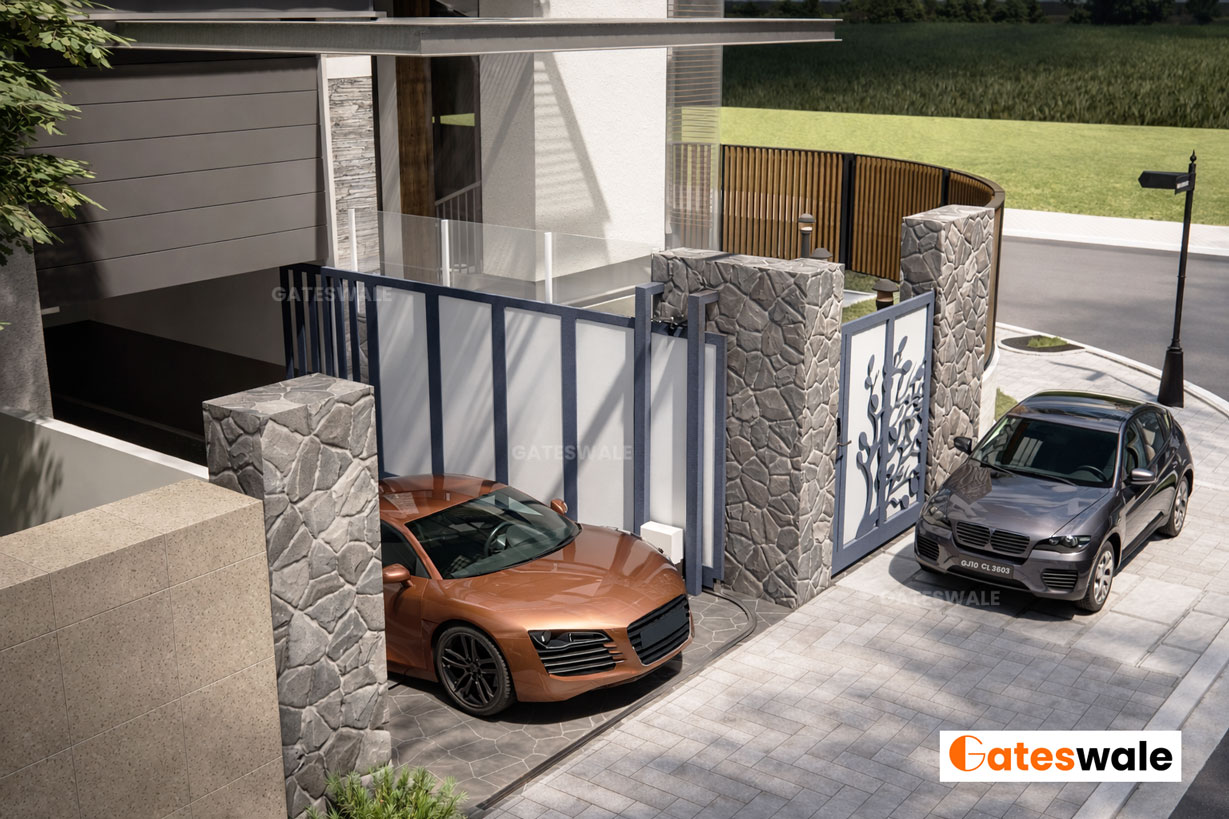
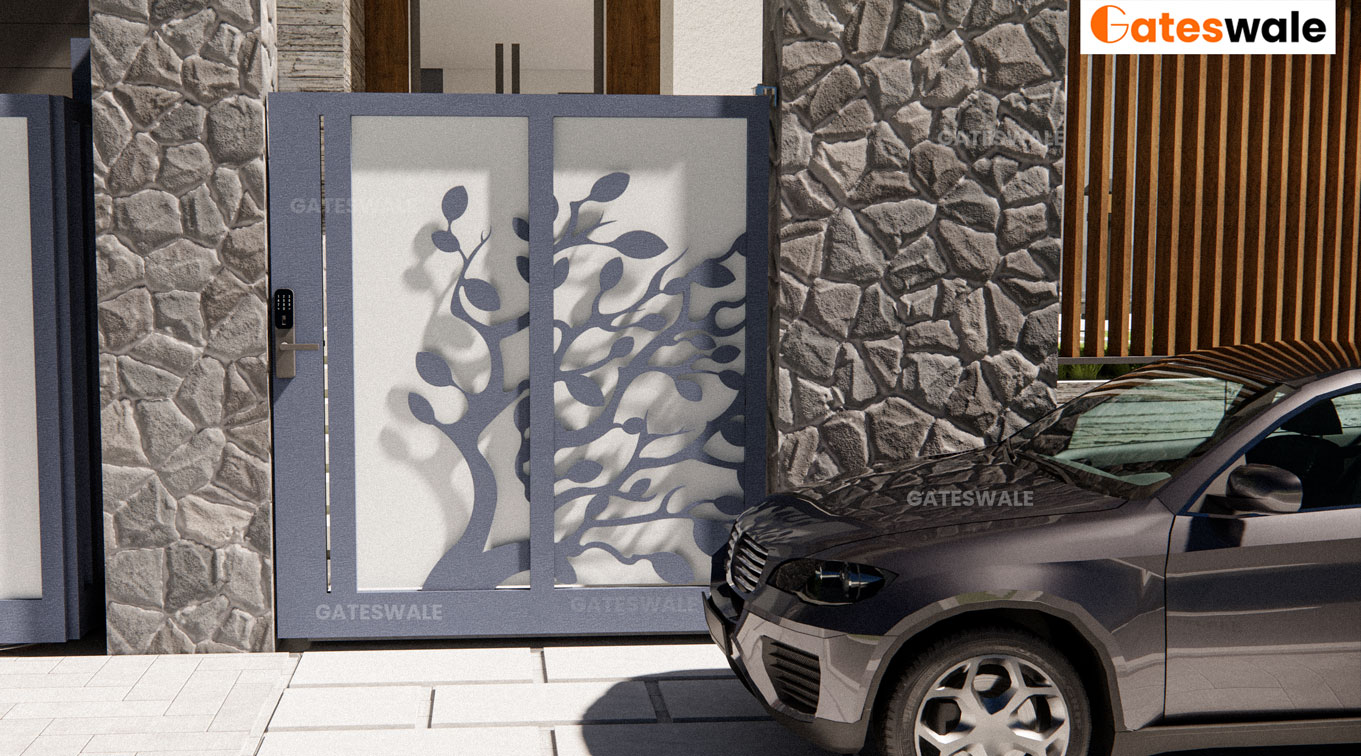
Key specs
Width
13'
Height
6'
Weight
450 KG
Automatic/
Manual
- Mead steel
GATE DESCRIPTION
What Is a 90° Corner Turning Sliding Gate?
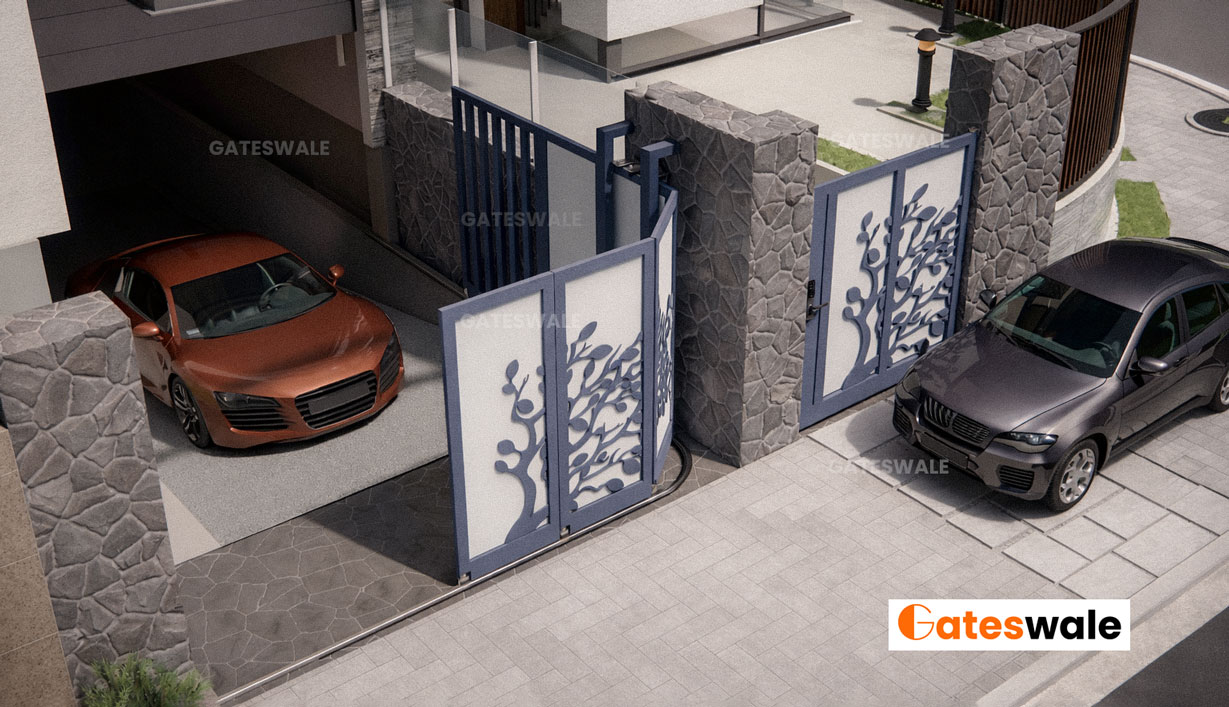
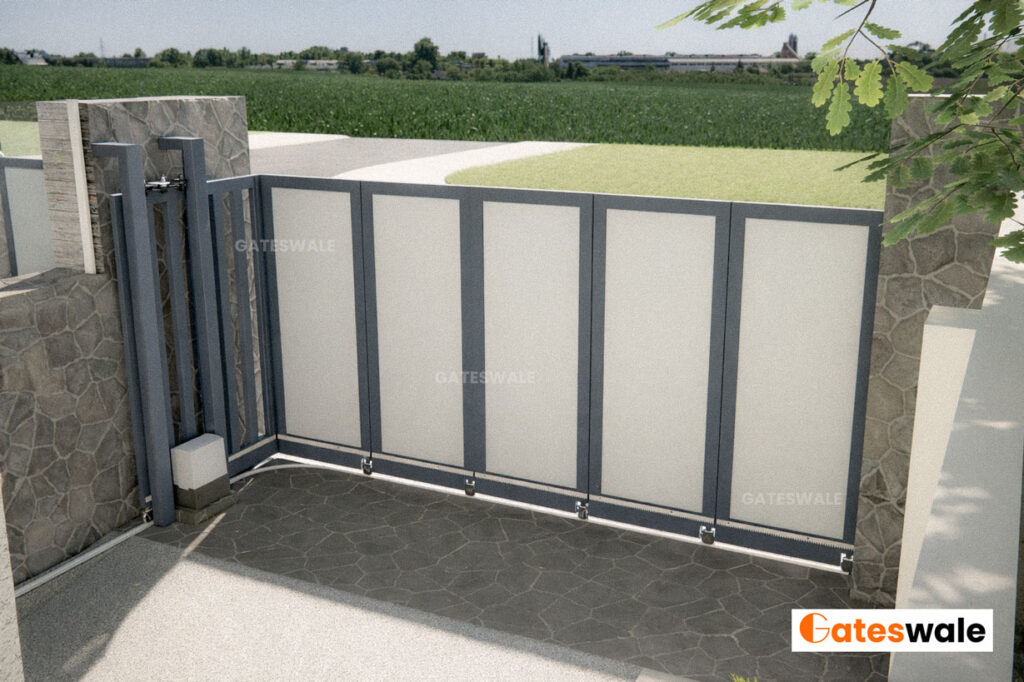
A 90-degree corner turning sliding gate — commonly called a corner slider or folding sliding gate — is one of the most space-efficient and architecturally elegant residential gate solutions available today. Unlike a conventional sliding gate that needs a long straight run of wall to park behind, this gate slides forward along the front boundary and then turns a full 90 degrees, tucking neatly along the side wall or driveway edge into the corner.
The gate achieves this by riding on a curved O-profile track set into the ground. As the panels travel forward, they follow the pre-formed curve and rotate into their parked corner position — completely clear of the driveway entrance, and visually out of the way. When closed, you see a beautiful solid gate face. When open, the panels are hidden around the corner.
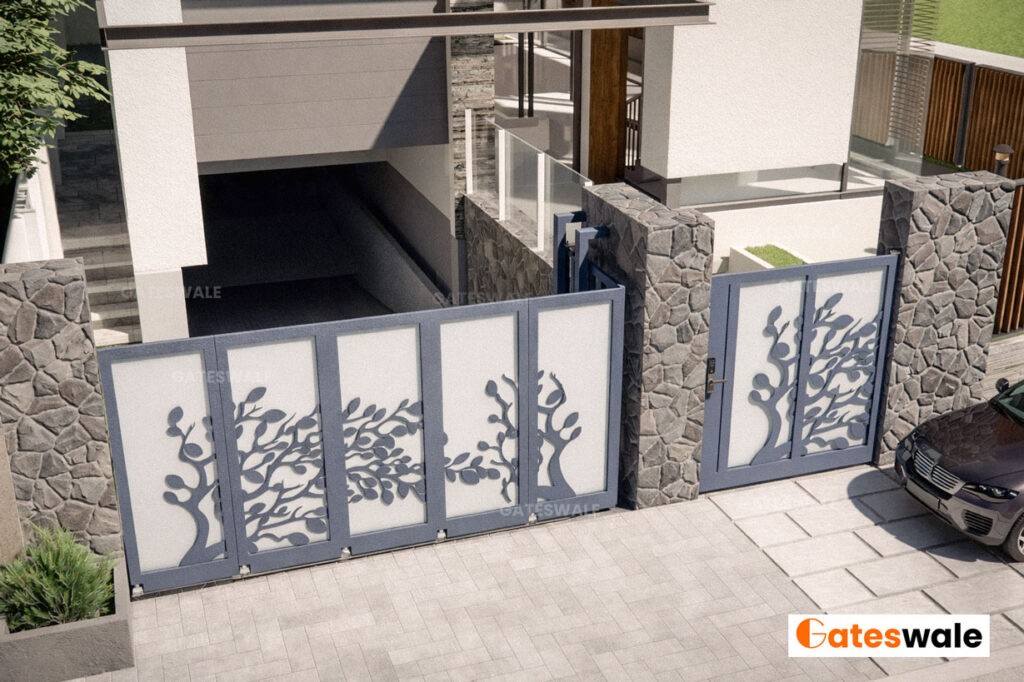
A well-designed gate is not just an entrance — it’s the first impression of your home.
This is the mechanism behind the gate shown in the renders above. The panels do not fold against each other like an accordion — they remain rigid and slide as a connected train. The curved ground track does all the turning. This distinction is critical for understanding how the gate is built, what hardware it requires, and why installation expertise matters so much for automation.
Why Choose a 90° Corner Sliding Gate Over a Regular Sliding Gate?
The single biggest practical advantage of a 90-degree corner turning sliding gate is that it requires almost zero straight wall space running alongside the opening. A standard 13-foot sliding gate needs at least 14 feet of clear wall beside the entrance to park behind. Many urban and semi-urban properties simply do not have that — especially corner plots or homes where the boundary wall ends shortly after the gate opening.
The CNC Tree Pattern — What Makes This Design Unique
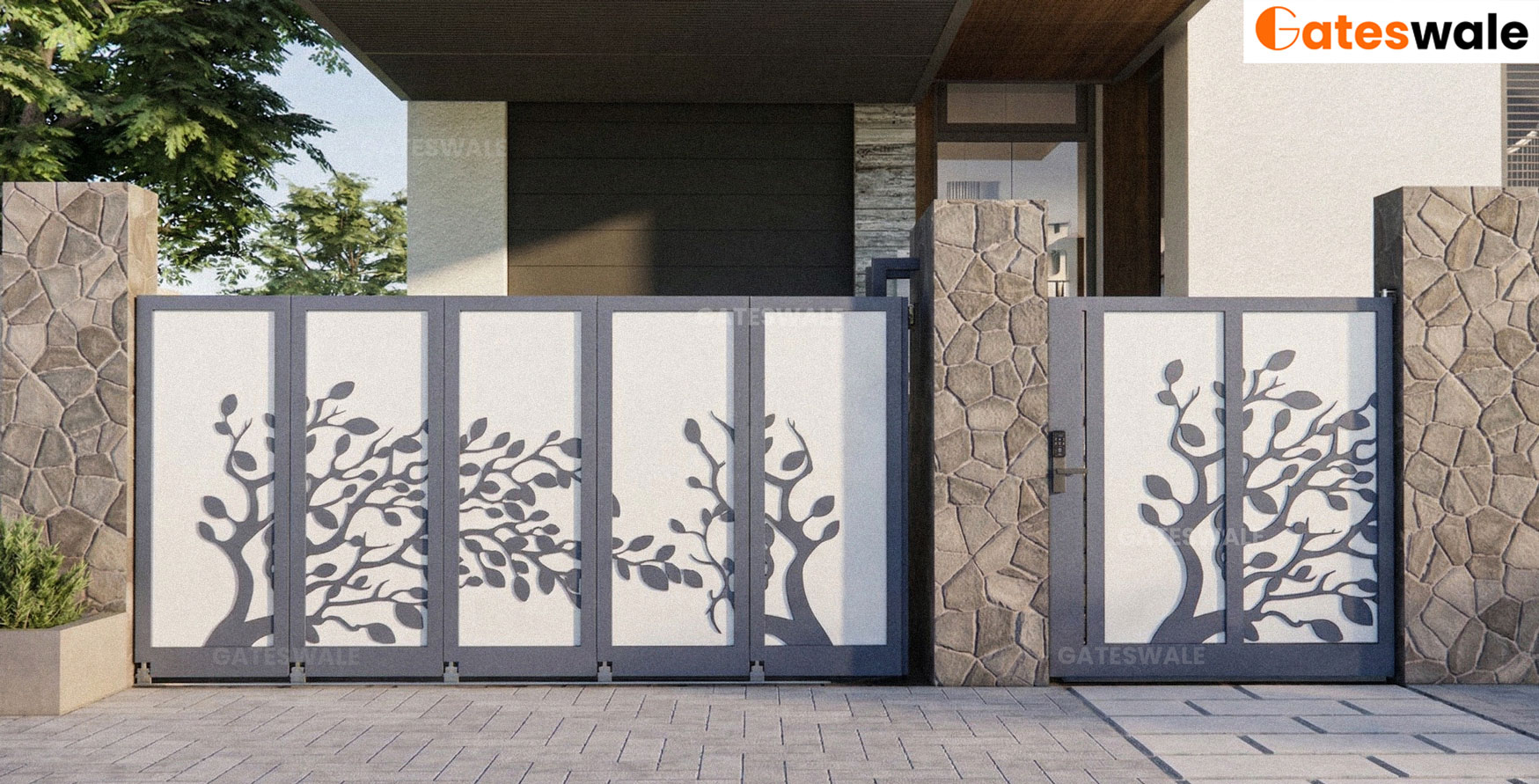
This gate was custom-designed for a specific client and it shows in one key detail: the CNC-cut tree pattern was not applied independently to each panel. Instead, the tree was designed as a single continuous artwork spanning all five panels simultaneously. When the gate is closed, you see one seamless composition — roots at the base, trunk rising through the centre panels, branches and leaf clusters flowing toward the edges. The individual panel joints disappear into the design.
How CNC cutting works in metal gate panels
Each panel uses a 3mm CNC-cut sheet layered over a solid 3mm metal infill sheet inside the frame. This creates genuine physical depth — light passes through the tree cut-outs but a solid backing sits behind, keeping the gate opaque and secure. The dark grey frame against the lighter painted infill sheet produces a dramatic two-tone contrast that looks striking in both direct sunlight and under exterior lighting at night.
Full Gate Specifications At A Glance
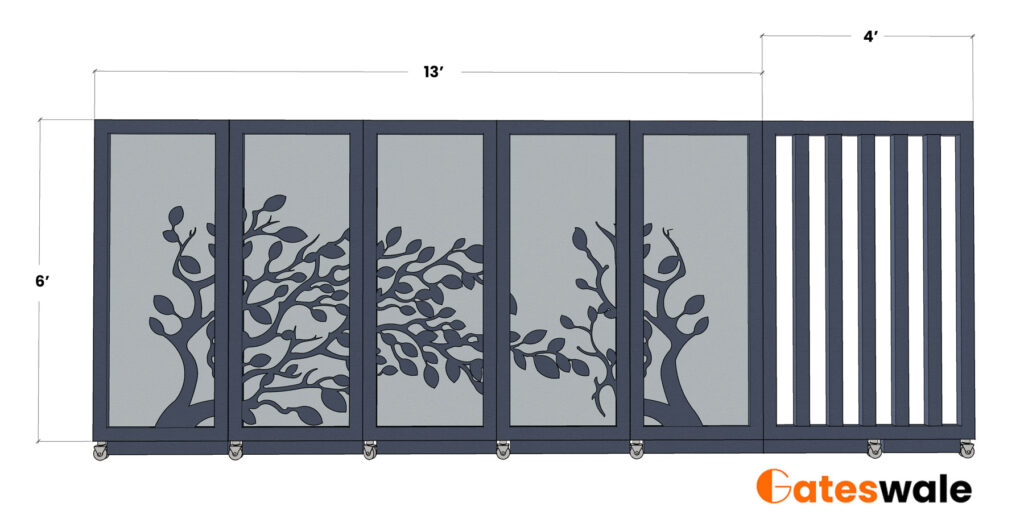
Gate Size & Structure Details
- Main Gate Width: 13 feet
- Gate Height: 6 feet
- Wicket Gate Size: 5 feet (width) × 6 feet (height)
- Total Panels (Front): 5 panels
- Extra Support Panel: 1 panel (4 feet width)
- Single Panel Width: 31 inches
This structure ensures balance, strength, and smooth operation, even for large entrances.
Material & Build Quality
We focused on durability and long-term performance while designing this gate.
Main Frame
- Material: Hollow rectangular pipe
- Size: 3 × 1.5 inches
- Thickness: 3mm
Inner Design
- Base Sheet: 3mm thick metal sheet
- CNC Design: 3mm thick tree-pattern cut sheet
This combination provides:
- Strong structural support
- Premium visual appeal
- Long-lasting durability
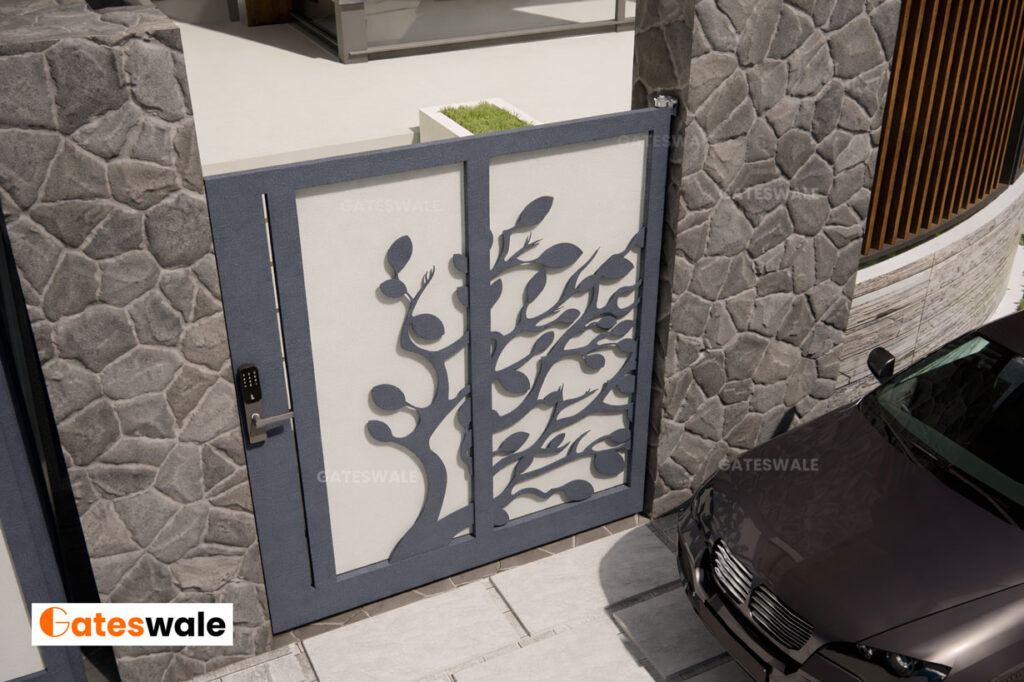
The Matching Wicket Gate — Design Continuity
The most common visual mistake in residential gate projects is treating the pedestrian wicket gate as an afterthought. A beautifully designed main gate paired with a generic tube-frame pedestrian gate looks architecturally incoherent — it signals that the entrance was assembled, not designed.
This project avoids that entirely. The wicket gate — 5 feet wide, 6 feet tall — uses the exact same CNC tree pattern, the same 3×1.5 inch rectangular pipe frame, the same 3mm infill and CNC overlay sheets, and the same dark grey powder coat finish as the main sliding gate. The tree pattern on the wicket gate continues the same design language, scaled to the smaller opening. From the street, both gates read as one unified composition framed by the rough-cut stone pillars — a complete entrance, not a gate plus an accessory.
Gate Hardware Used
For smooth and reliable performance, we used premium hardware components:
Wheels
- 360° rotating heavy-duty wheels
- Smooth movement even for heavy gates
Track System
- O Profile Bottom Track
- Pre-designed 500 radius
- Perfect for 90-degree movement
- No noise or jamming
Guide System
- Teflon roller guide for stability
🔩 Why Special Hinges Are Important
Most people use parliament hinges, but they are not ideal for folding gates.
We used specialized folding gate hinges because:
- They allow smooth 90° movement
- Reduce friction
- Prevent alignment issues
This is a critical factor for long-term performance.
Gate Automation — Long-Term Peace of Mind
Manually sliding a 13-foot multi-panel gate with a heavy metal infill every time you leave or return home is impractical for daily life. On a gate of this size and weight, automation is a practical necessity. This design is built around DC brushless motor automation — the right specification for a gate of this mechanical complexity.
Why DC brushless motors outperform brushed motors
Traditional gate motors use brushed DC motors where carbon brushes make physical contact with a rotating commutator. These brushes wear down over time, need periodic replacement, generate more heat, and produce electrical interference. A DC brushless motor eliminates the brushes entirely — current is managed electronically, with no mechanical wear in the drive system. For a residential gate cycling 6 to 10 times per day, a brushless motor routinely lasts 15 to 20 years. A brushed motor in the same application typically needs servicing within 5 to 7 years.
FULL SPECS & FEATURES
| Dimension | Width: 13' | Height: 6' |
|---|---|---|
| Depth: 3" | ||
| Gate Weight | 450 KG (Approx.) | |
| Gate Material | Milled steal | Milled steal |
| Gate Wheels | Heavy Duty Revolving Gate Wheel 360° Suitable for Turning Sliding Gate | |
| Support Roller | 1.25" Teflon Rollers | |
| Bottom Rail | Stainless Steel 20mm O Profile Bottom Track & Corner radius 500mm | |
| Automation | DC/AC Power High Speed Gate Operator With 500kg Capacity | |
| Colour | Grey & Smoke White |
Cost Breakdown for Folding Gate Design (Estimated)
- Gate Fabrication cost :- ₹ 80000
- Gate Paint and Primer :- ₹ 35000
- Gate Hardware:- ₹ 60000
- Gate Automation:- ₹ 130000
- Other Accessories :- ₹ —
Maintenance & Longevity Tips
Wash the gate every three to four months with mild soapy water to remove road dust, bird droppings, and atmospheric pollution. These deposits are mildly acidic and will slowly degrade the coating if left to accumulate. Avoid pressure washing directly at CNC-cut panel edges — high-pressure water can lift the coating at the cut edges over time.
Clean the O-profile track monthly. Dust, small stones, and leaf litter collect in the channel and cause the wheels to bounce or bind. A dry cloth or stiff brush is enough. Do not grease the O-profile track — grease attracts grit and creates an abrasive paste that accelerates wear on both track and wheels. The 360-degree wheels and Teflon top rollers are self-lubricating and need no additional lubrication.
Check all inter-panel hinge joints every six months for lateral play. A small amount of initial settling is normal — re-torque fixing bolts to the fabricator's specified value. Do not over-tighten, which can crack weld seats on the panel frames.
Once per year, have your automation installer check the gear rack mesh condition, verify motor torque limit settings, test obstacle detection sensors, and confirm remote and app connectivity. Catching a worn rack tooth or drifting torque setting costs very little proactively — and a great deal after a failure.
This Folding Gate Design For Your Home is a perfect combination of:
- Engineering precision
- Premium materials
- Unique artistic design
The tree CNC pattern, smooth folding mechanism, and strong structure make it a top trending gate design for modern homes.
If you want a gate that is both functional and visually stunning, this design is definitely worth considering.
A 90-degree corner turning sliding gate with a custom CNC tree pattern is not something you pick off a catalogue. It is the result of thoughtful design, correct material specification, precise fabrication, the right hardware, and experienced automation installation — all working together. The gate in this guide shows exactly what is possible when every element is chosen with intention: 13 feet wide, 5 seamlessly patterned panels, O-profile curved track, DC brushless motor, and a matching wicket gate. Your home deserves an entrance that reflects the care that went into everything inside it.
Frequently Asked Questions
t is a sliding gate where the panels slide forward along the front boundary wall and then follow a pre-curved ground track to turn a full 90 degrees, parking along the side wall in the corner. The panels stay rigid — the curved O-profile track guides the turn. This allows the gate to open without needing any long straight wall space running alongside the entrance opening.
The gate turns into the corner beside or behind the boundary pillar, consuming minimal driveway width. The side wall depth it occupies when parked is determined by the gate panel arrangement in the corner — typically 4 to 5 feet of side wall. This is dramatically less than the 14-plus feet of straight wall a standard 13-foot sliding gate would require.
Most steel fabricators can attempt one, but building it correctly — with the right track radius, hinge specification, wheel type, and automation alignment — requires specific prior experience. Always ask for a portfolio of completed corner-turning sliding gate projects specifically. A fabricator who has not built this type before will make mistakes that are expensive to correct after installation.
For a 13-foot gate with 5 CNC-patterned panels, 3×1.5 inch frame, O-profile curved track, 360-degree wheels, and a matching 5-foot wicket gate, fabrication in India typically ranges from ₹3 lakh to ₹4 lakh depending on city, fabricator quality, and finish. DC brushless motor automation adds approximately ₹25,000 to ₹45,000 on top. Powder coating is usually included in the fabrication quote.
The O-profile track is pre-fabricated with a 500mm radius curve built in. This is what physically guides the gate through its 90-degree turn. Standard flat or V-groove tracks used in straight sliding gates do not have this built-in curve. Using the wrong track type on a corner-turning gate causes the wheels to grind at the bend, leading to noise, damage, and eventual jamming.
Most modern DC brushless gate motors accept optional Wi-Fi or GSM module add-ons enabling smartphone app control, remote operation, event logging, and integration with video doorbell systems. Confirm smart home compatibility with the specific motor model before purchasing — established brands typically offer these modules as optional accessories to their residential brushless motor range.
Quality powder coating on properly prepared steel lasts 10 to 15 years in normal outdoor conditions. In coastal or high-humidity areas, expect 7 to 10 years. Regular washing significantly extends coating life. For coastal locations, specify zinc phosphate pre-treatment before powder coating — it adds a corrosion-resistant base layer that meaningfully extends the coating's service life.